Forklift Battery Maintenance: Handling & Best Practices
Proper forklift battery maintenance can extend battery life, improve forklift performance, reduce downtime, and help prevent costly repairs. From proper charging and watering to safe handling and routine inspections, following the right maintenance practices helps protect your battery investment and keep your equipment operating efficiently.
Proper Forklift Battery Handling
Forklift batteries can be heavy and dangerous if not handled properly, so it’s important to be educated on the correct way to handle them. Use these tips for some ideas about handling batteries properly:
- Use special equipment, like a walkie pallet jack equipped with a transfer carriage, to maneuver the battery. Because of the weight of some forklift batteries, no single person should attempt to move a forklift battery alone. Steel toe shoes should also be worn while moving the batteries.
- An eye and hand washing station should be nearby. Should any hazardous liquid come in contact with hands or eyes, a hand and eye washing station should be conveniently located nearby to remove it as quickly as possible.
- Chemical-resistant protective gear should be worn while maneuvering batteries. Having a conveniently located eye and hand washing station is necessary, but chemical-resistant gear should also be worn to keep the need for the station at bay. This includes safety glasses and gloves.
- Remove all metallic jewelry when handling and charging.
How to Properly Charge a Forklift Battery
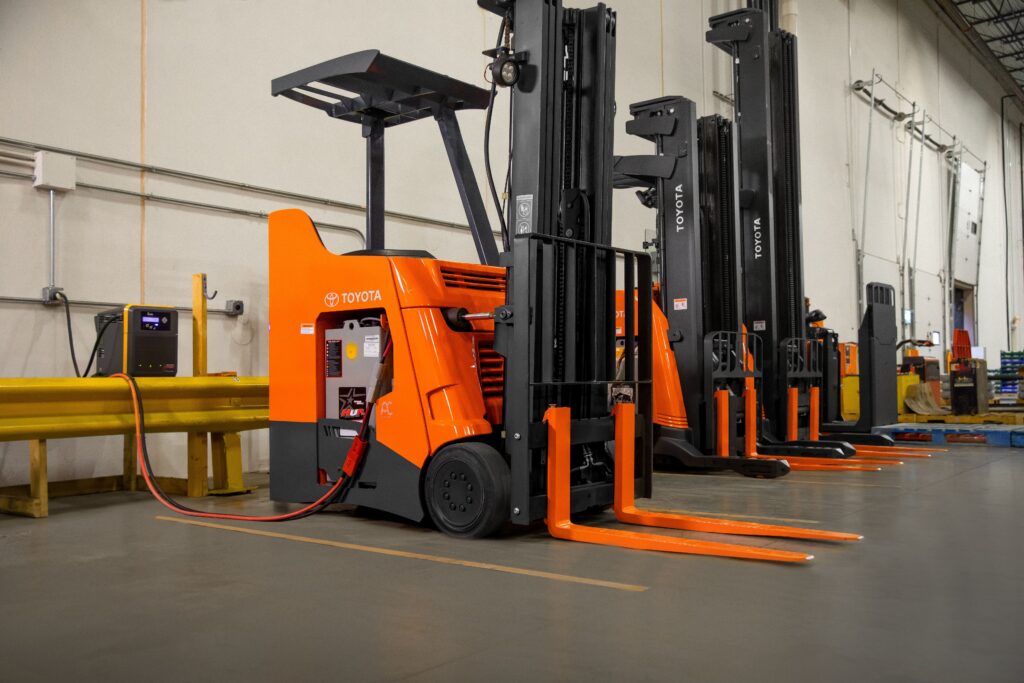
Proper charging is an important part of forklift battery maintenance. Following the battery and charger manufacturer’s recommendations can help extend battery life, maintain performance, and reduce premature battery damage. Use these tips when charging your forklift battery:
- Charge forklift batteries only in designated battery-charging areas. OSHA requirements address designated charging areas and appropriate facilities for safely charging and handling forklift batteries.
- Remember that lead acid batteries should be charged at 80 percent depth of discharge. Charging prior to 80 percent can result in reduced battery life depending on the type of battery. Discharging the battery past 80 percent depth of discharge can also be detrimental.
- If your battery overflows, take time to rinse it. Rinsing your battery after an overflow will help prevent corrosion.
- Ensure compatibility between the battery and the charger. The charger that is being used should match the voltage/amperage of the battery. Color coding the connectors and clearly labeling the chargers can help to prevent accidentally connecting a battery to the wrong charger. Proper training is also imperative.
- Avoid overcharging the battery. Some batteries have battery management systems that can prevent overcharging. If yours doesn’t, take precautions not to overcharge it, which can reduce the battery’s life.
- Charge and operate the batteries at the proper temperature. Charging a battery in extreme cold or heat can cause reduced service life. Since battery types and specifications may vary, contact the battery manufacturer for their recommended charging temperature range.
- Add water when needed after the charging cycle. Adding water to a wet-cell battery prior to charging the battery is a common mistake. Pure or distilled water should be used and the watering should occur after a full charge cycle to bring the electrolytes to the proper level.
- Ensure the charger is turned off before connecting or disconnecting the battery.
How to Water a Forklift Battery
Proper water levels are essential for maintaining traditional lead-acid forklift batteries. Water should generally be added after the battery has completed a full charge cycle. Watering before charging can cause the electrolyte to overflow as it expands during charging. If the battery plates are exposed, follow the battery manufacturer’s instructions before charging. Always follow the maintenance recommendations for your specific battery.
Signs Your Forklift Battery May Need Attention
Routine inspections can help identify battery problems before they lead to unexpected downtime. Watch for corrosion, damaged cables or connectors, unusually short run times, charging issues, excessive heat, or problems maintaining proper water levels. If battery performance changes noticeably, have the battery and charging system inspected by a qualified technician.
Forklift Battery Maintenance in Idaho & Utah
Dillon Toyota Lift helps businesses throughout Idaho and Utah maintain reliable electric forklift fleets with battery and charger support, forklift service, planned maintenance, and energy solutions. Our team can help evaluate your battery application, charging needs, and overall fleet requirements to help improve uptime and equipment performance.
Frequently Asked Questions About Forklift Battery Maintenance
How often should you maintain a forklift battery?
Forklift batteries should be inspected regularly as part of routine forklift maintenance. Maintenance frequency depends on the battery type, application, operating environment, and usage. Always follow the battery manufacturer’s recommended maintenance schedule.
When should you add water to a forklift battery?
For traditional lead-acid forklift batteries, water is generally added after the battery has completed a full charge cycle. Always follow the manufacturer’s instructions for proper water levels and watering procedures.
How do you know when a forklift battery needs to be replaced?
Signs may include noticeably shorter run times, difficulty holding a charge, excessive heat, corrosion, damaged components, or declining performance. A qualified technician can evaluate the battery and charging system to determine whether service or replacement is needed.

Can you overcharge a forklift battery?
Yes. Improper charging can reduce battery life and performance. Use a charger that is compatible with the battery and follow the battery and charger manufacturers’ charging recommendations.
Do lithium-ion forklift batteries require the same maintenance as lead-acid batteries?
No. Lithium-ion batteries have different maintenance and charging requirements and typically do not require watering. Always follow the manufacturer’s instructions for the specific battery installed in your forklift.
Share this Post
Other Post


UNDERSTANDING DIFFERENT FORKLIFT TYPES AND THEIR APPLICATIONS

10 Things You’ll Learn in Forklift Operator Safety Training